
In today's fast-paced B2B environment, achieving and maintaining high sales performance is critical to the success of any organization. However, when sales fails to meet expectations, ‘the sales problem’ is often immediately pointed at and anticipated. In most cases, this only leads to symptom relief or putting a Band-Aid on a wound that is too deep.
What are major causes of disappointing sales?
In practice, we see that when sales performance falls short of expectations, people often have an immediate idea of why. Some believe in extra tooling, some in firing and hiring new people, others in extra training or coaching and this can certainly contribute in the short term, but more is needed to achieve lasting results. Of course, fundamentally there needs to be a good product-market fit and a good sales funnel strategy. This is indisputable, but to actually be successful for the longer term it is crucial To also take a holistic and integrated approach to maximize the sales team in this way! People do business with people and sales is the result of a human relationship. Stimulating present sales talent in the organization combined with providing the right resources is a first step that contributes to a successful sales strategy. That sounds logical right? Yet where does it often go wrong? Because practice is more obstinate. An organization involves people, sometimes even many people and multiple business units that - in order to achieve sublime sales - must work together seamlessly and be in the right balance with each other.
Importance of Balance and Alignment
To further explain this visually and where imbalance can occur, among other things, I outline below 3 examples we see a lot in organizations.
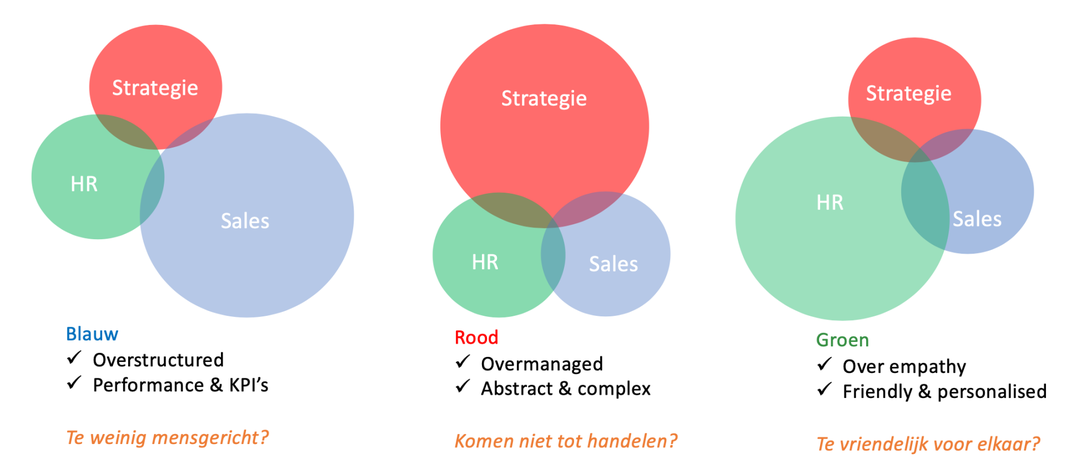
- Red represents Strategy, board/management;
- Blue for Sales - processes, structure, data driven;
- Green for HR - people, talent development and attention.
In the first example, we see a blue organization. Well structured, adequate tooling and data driven. Huge focus on sales performance and KPIs and as a logical consequence often a reporting culture. However, this organization lacks the ‘people’ side and in addition to the sales overviews and micro-managing that is common here, this organization will most likely face a high sales talent turnover because sales talent in this organization often does not get the attention and recognition needed to continue to perform long term.
In the second example, we see a typical red organization. A lot of management at the top who knows exactly where the organization needs to go, along with many management processes and the necessary hierarchical lines. Sales will be less aligned with the overall organizational strategy because of the complex business structure. In addition, being able to anticipate changes - needed in the product or service to properly serve the market - in an agile manner will simply take longer. Sales will have a harder time getting off the ground.
In the third example, we see a real green organization and puts people first. The organizational culture is very social and involved. This situation often occurs in family businesses or organizations with a long history. Sales goes okay and if things don't go well then it is more or less covered with the cloak of love. Because he has been working here for so long ... or...... we have been doing it this way for years. Sales performance and velocity are hardly ever measured and, in all honesty, the current sales team usually no longer fully meets what the market really needs. Buyers are in fact much better informed than before and work for example with data driven information where they are actually looking for knowledgeable sparring partners.
None of the above example organizations is likely to achieve sublime sales. There is simply an imbalance and insufficient alignment between the 3 main areas. In fact, below the 3 main areas are subdomains with underlying processes that also need to be in good synergy with each other and for which people are responsible.
Conclusion
Achieving maximum sales team performance is no easy task and, in addition to alignment and good coordination also to be human, process and strategic in balance are. In the Husaca philosophy, we see successful sales organizations working with an integrated sales methodology that takes these interests into account and in this way maximizes sales team velocity.
If sales in your organization is not bringing the performance you desire, take a critical look to see if these three main areas are integrally aligned OR if one specific color - or in some cases, even more than one color - stands out!
In fact, red, green and blue colors in the right combination produce a WHITE light. And precisely in this white light lies the key needed to achieve sublime sales team performance in an organization! And that's where we like to shine our light!